
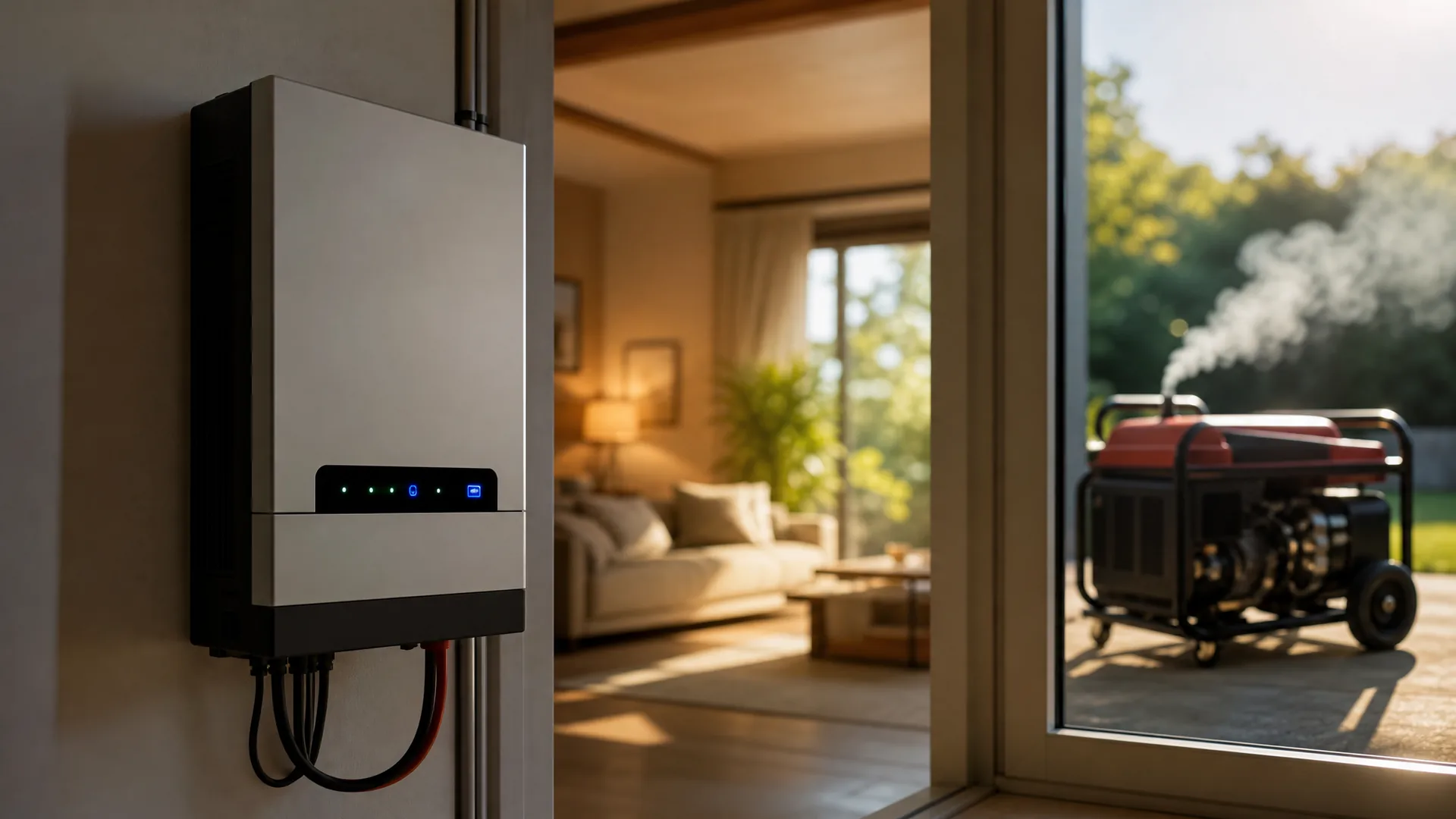
Generator Vs Inverter Battery Backup: Which Suits Your Home?
If you’re tired of sitting in the dark during load shedding, the choice between a generator and an inverter battery backup is probably the most important decision you’ll make for your home. Both solve the same problem, keeping your lights on when Eskom cuts power, but they work very differently, cost different amounts to own and run, and suit very different living situations. This guide breaks down exactly what each option involves so you can make a confident, informed decision.
The Core Difference: How Generators and Inverter Battery Systems Work
How a petrol or diesel generator works
A generator burns fuel, petrol or diesel, to spin a motor, which then produces electricity on demand. You start it manually or with a key, it roars to life, and it powers whatever you plug into it. Output is immediate but comes with noise, exhaust fumes, and a continuous fuel cost for every hour it runs. Generators have no power storage; the moment you switch them off or run out of fuel, your power stops.
How an inverter battery backup system works
An inverter battery backup system stores electricity in a battery bank and converts that stored energy into usable AC power through an inverter. The battery charges from the grid when power is on, and the inverter switches over automatically, usually within milliseconds, the moment an outage starts. There are no moving parts, no fuel, and no noise. Modern systems use a pure sine wave inverter, which produces a clean electrical output safe for sensitive electronics.
Generator vs Inverter Battery Backup: Side-by-Side Comparison
The table below is the clearest way to understand the full picture before spending any money.
| Feature | Petrol / Diesel Generator | Inverter Battery Backup |
|---|---|---|
| Noise level | 65–85 dB (loud, comparable to a lawnmower) | Silent (0 dB during operation) |
| Upfront cost | Lower (entry-level units from ~R3,000–R15,000) | Higher (quality systems from ~R20,000–R60,000+) |
| Running cost | High, depends on fuel price per litre, per hour | Near zero, only the cost of the grid electricity used to recharge |
| Fuel dependency | Requires constant petrol or diesel supply | None, charges from grid or solar panels |
| Maintenance | Regular: oil changes, spark plugs, air filters, fuel stabiliser | Minimal: battery health checks every 1–2 years |
| Switchover speed | Slow, must be started manually (or 10–30 seconds for auto-start units) | Fast, typically under 20 milliseconds; most electronics don’t even notice |
| Load-shedding suitability | Good for extended outages with fuel available | Ideal for Stage 2–6 slots; duration limited by battery capacity |
| Safe for electronics | Inconsistent sine wave output can damage sensitive devices | Pure sine wave output is safe for TVs, laptops, routers, and medical equipment |
| Emissions | CO and exhaust fumes, not safe indoors | None |
| Allowed in flats/estates | Often prohibited by body corporate rules | Fully compliant in almost all living situations |
The generator vs inverter battery backup decision often comes down to how you live, not just how much you want to spend.
Backup Power Cost Comparison: What South African Homeowners Actually Pay
Upfront installation costs
Generators win on entry price. A basic petrol generator capable of running lights and a few appliances costs between R3,000 and R15,000. A mid-range diesel standby unit with auto-start can run to R30,000 or more. A properly sized inverter battery backup system, inverter unit, battery bank, wiring, and installation by a qualified electrician, typically starts around R20,000 for a modest setup and rises to R60,000 or beyond for a whole-home system with LiFePO4 batteries. Explore the range of solar battery backup systems available in South Africa to get a sense of current sizing and pricing options.
Ongoing fuel and maintenance costs
This is where the calculation flips. South African petrol and diesel prices have risen sharply in recent years, and with frequent load shedding, Stage 4 rotations mean roughly 12 hours without power per day, fuel costs accumulate fast. Running a mid-sized generator through a two-hour Stage 4 slot consumes roughly 1–2 litres of fuel per hour. At current pump prices, daily generator use during heavy load shedding stages can easily cost R60–R120 per day, which becomes R1,800–R3,600 per month. Over one to two years, that fuel spend erodes the generator’s lower upfront price advantage entirely.
Inverter battery systems, once installed, cost only a fraction of that in electricity to recharge, and if you combine the system with solar panels, recharging can be free. Maintenance is also minimal compared to a generator, which needs regular oil changes, filter replacements, and mechanical servicing to stay reliable.
Noise, Neighbours, and Body Corporates: The Silent Backup Power Advantage
A generator running at 70–80 dB is genuinely disruptive, to you, your family, and every neighbour within earshot. In a dense suburb or complex, that’s a real problem.
Many South African sectional title schemes and security estates have noise bylaws or body corporate rules that effectively ban petrol generators, making silent inverter-battery systems the only compliant option for residents in those complexes. This is one of the most practical reasons the generator vs solar battery system debate resolves differently for flat and townhouse dwellers than it does for freestanding homeowners on large plots.
Beyond the rules, there’s the safety issue. Generators produce carbon monoxide and must never be run indoors, in a garage with the door closed, or in any enclosed space, a hazard that has caused fatalities in South Africa. Inverter battery systems produce no emissions at all and can be installed inside a home, a cupboard, or a dedicated utility room.
For anyone in a security estate, townhouse complex, or flat, silent backup power systems are not just more convenient, they’re often the only legal and safe option available.
Which Loads Can Each System Handle? Matching Backup Power to Your Needs
Not all appliances are equal, and this matters when choosing between an inverter backup and a diesel generator.
Sensitive electronics, TVs, laptops, routers, smart home devices, medical equipment, benefit strongly from the clean pure sine wave output of a quality inverter battery system. Some generators produce a modified sine wave that can cause overheating, shortened lifespan, or outright damage to these devices. If protecting electronics is a priority, the inverter wins.
High-draw appliances, electric geysers, stoves, tumble dryers, air conditioners, consume large amounts of power. Running these on a battery system requires a much larger (and more expensive) battery bank. A generator handles them more cheaply in terms of upfront cost, because you’re burning fuel rather than storing and converting large amounts of energy. For most homeowners, the practical approach is to avoid running high-draw appliances during outages regardless of which system they use, or to go the hybrid route.
The hybrid option is worth considering: an inverter battery system combined with adding solar panels to your backup system gives you silent, fuel-free power that recharges itself during daylight hours. This is increasingly the preferred long-term solution for South African homes facing ongoing energy instability.
Before buying anything, get a professional load assessment done. Qualified electricians consistently advise this because oversizing wastes money and undersizing leads to equipment damage or a system that cuts out mid-outage. It’s also the only reliable way to know whether your current wiring needs any electrical fault finding and repairs before a new system is connected.
Which Backup Solution Is Right for You?
Here’s a simple decision guide based on the most common situations:
Choose an inverter battery backup system if:
- You live in a flat, townhouse, or security estate with noise restrictions
- Your primary need is keeping lights, a router, a TV, and a fridge running through a standard 2–4 hour load shedding slot
- You want automatic, instant switchover with no manual steps
- You plan to add solar panels to eliminate ongoing charging costs
- Protecting sensitive electronics is important to you
Choose a generator if:
- You live in a freestanding home on a large property with no noise restrictions
- You need to power high-draw appliances and can’t justify the battery bank cost to do so
- You face very long or unpredictable outages where battery capacity would run out
- Your budget doesn’t allow for a full inverter-battery installation right now
Consider a hybrid system if:
- You want the resilience of generator backup for extended outages combined with the silence and convenience of battery backup for daily load shedding
- You’re planning a longer-term energy independence strategy
Whichever direction you’re leaning, consult the load shedding backup power solutions for South African homes resource for a broader overview, and check out the best solar inverters for home use in South Africa if an inverter-battery system looks right for you.
The single most important step before any purchase is a professional load assessment. Electricians Near Me offers a FREE call-out across South Africa, a qualified electrician visits your property, calculates exactly what load you need to back up, and gives you a clear, personalised recommendation. There’s no commitment and no pressure. Book your free assessment today and get the right backup power solution the first time.


About author




Add comment