
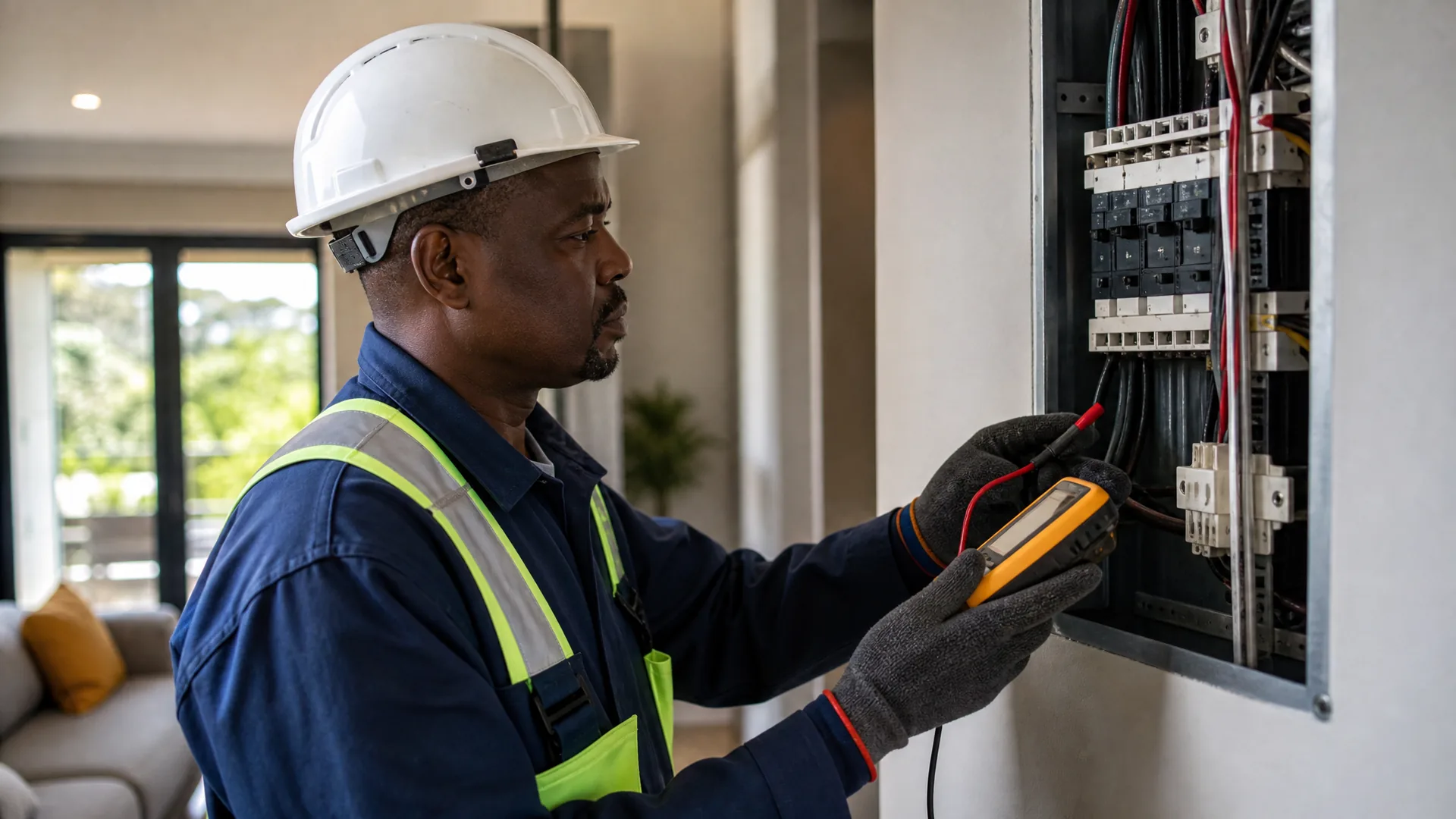
Electrical Safety Certificate Home Inspection: SA Guide 2026
If you’re buying, selling, or renovating a home in South Africa, an electrical safety certificate home inspection is not optional, it’s a legal requirement. Yet many homeowners searching online find results dominated by UK or Australian guidelines that simply don’t apply here. South Africa has its own regulatory framework, its own standards body, and its own authorised inspectors. This guide explains exactly what you need to know as a South African property owner in 2026.
What Is an Electrical Safety Certificate in South Africa?
The Certificate of Compliance (CoC) Explained
In South Africa, the document you need is called a Certificate of Compliance, commonly referred to as a CoC. It is issued by a registered Electrical Installation Inspector and confirms that an electrical installation meets the minimum safety requirements set out in South African law. Without a valid CoC, a property sale cannot legally proceed, and an unregistered installation carries serious liability risk for the owner.
The CoC is not a guarantee that every component is new or perfect. It certifies that the installation is safe and compliant at the time of inspection, and that is what the law requires.
How It Differs from a General Home Inspection
A general home inspection covers the condition of a property broadly: roof, plumbing, damp, structural elements. An electrical safety certificate home inspection is specific to the electrical installation only. It follows a defined technical checklist under SANS 10142-1 and results in a legally recognised compliance document, something a general building inspection cannot produce. If a conveyancer or buyer asks for a CoC, a general home inspection report does not satisfy that requirement.
Electrical Certificate Requirements Under South African Law
The Occupational Health and Safety Act and SANS 10142
The governing framework has two layers. The Occupational Health and Safety Act (Act 85 of 1993), along with its Electrical Installation Regulations, sets the legal obligation for a CoC. SANS 10142-1 is the South African National Standard for the wiring of premises and forms the technical benchmark every registered inspector uses when assessing a property. Any installation that does not meet this standard cannot receive a valid CoC.
Together, these two instruments define both who must comply and what compliance looks like. They are the reason a homeowner in Cape Town and one in Limpopo are held to the same wiring standard.
When Is a CoC Legally Required?
Under the OHS Act and its Electrical Installation Regulations, a CoC is a legal requirement in three situations:
- Property sale, a valid CoC must be provided to the purchaser before transfer.
- New electrical installation, any new installation must be certified before it is energised or used.
- Substantial alteration or addition, work that significantly changes an existing installation triggers a new CoC obligation.
Day-to-day maintenance or minor repairs, replacing a socket, for example, do not automatically require a fresh CoC. Any work that alters the installation’s configuration or capacity typically does. When in doubt, a registered inspector can advise whether your specific work crosses that threshold.
Only an inspector registered with the Department of Labour (DoL) under the Electrical Installation Regulations is legally authorised to issue a Certificate of Compliance. A CoC signed by an unregistered individual has no legal standing and can expose a seller to significant liability. Always verify registration before booking.
What a Home Electrical Safety Inspection Covers
Earthing, Wiring, and Distribution Board Checks
A standard home electrical safety inspection tests several critical systems. The inspector will check:
- Earthing continuity, confirming that all metalwork is properly earthed to prevent electric shock.
- Insulation resistance, testing that wiring insulation has not degraded to the point of risk.
- Circuit protection, verifying that miniature circuit breakers (MCBs) and residual current devices (RCDs, also called earth leakage units) are correctly rated and operational.
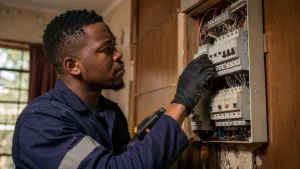
- Distribution board condition, checking for signs of overheating, incorrect wiring, or unsafe DIY modifications.
- Visible wiring, identifying exposed, damaged, or non-compliant cabling throughout accessible areas.
If a hazard is discovered during the inspection, you may need an emergency electrician near you before compliance work can begin. Safety comes first.
What Inspectors Look for in Older Homes
Older homes, particularly those built between the 1970s and 1990s, present the most common compliance challenges. A typical 1980s home in Johannesburg or Pretoria is likely to have a fuse-board rather than a modern circuit-breaker panel, aluminium sub-circuit wiring, and no earth leakage protection. All three are common CoC failure points that must be remedied before a certificate can be issued.
This does not mean an older home cannot get a CoC, it means remedial work is often needed first. A residential electrical inspection in Johannesburg will identify exactly which items need attention before the certificate can be issued. Knowing the scope upfront lets you plan remedial costs accurately rather than being caught off guard during a property transfer.
SABS Electrical Inspection and Who Can Issue a CoC
The South African Bureau of Standards (SABS) does not conduct residential electrical inspections and does not issue Certificates of Compliance. SABS is the standards body responsible for developing and publishing SANS 10142-1, the technical document inspectors work from. Its role is to set the benchmark, not to enforce it or certify individual properties.
The entity that authorises inspectors is the Department of Labour (DoL). Inspectors must register with the DoL under the Electrical Installation Regulations and carry proof of that registration. When people search for an “SABS electrical inspection,” they are usually looking for the official compliance process, but the correct term is a DoL-registered inspection resulting in a CoC.
This distinction matters practically: if someone offers you an “SABS certificate” as a standalone product, that is a misrepresentation of how the system works. Ask for the inspector’s DoL registration number and verify it before any work proceeds.
Electrical Compliance Certificate Cost: What to Expect in 2026
The cost of an electrical compliance certificate is not fixed, it varies based on property size, age, and location. A small, recently built home with modern wiring and a compliant distribution board will require fewer test points and less time, so the inspection fee is lower. A large, older property with complex wiring or multiple sub-boards will take longer and cost more.
It is also important to separate two distinct costs. The inspection fee covers the inspector’s time and the formal certificate if the installation passes. Remedial work costs are separate, they apply only if non-compliances are found and must be corrected before a CoC can be issued. Some homeowners budget only for the certificate and are surprised by repair costs. Getting an honest pre-inspection assessment helps avoid that situation.
For landlords or property managers with non-residential premises, the same principle applies, scope and complexity drive cost. If you manage commercial electrical installations in Pretoria, the inspection process follows the same regulatory framework but typically covers more circuits and distribution points.
If remedial work is needed, electrical fault finding and repairs carried out by the same registered team can streamline the process, one contractor handles the inspection, the remediation, and the final sign-off.
How to Book a Home Electrical Safety Inspection in South Africa
Booking a valid electrical safety certificate home inspection comes down to four steps: confirm the electrician holds DoL registration, request a written quote that covers both inspection and any likely remedial scope, agree on access arrangements for all areas of the property, and schedule at a time when the distribution board and all circuits are accessible.
Electricians Near Me sends DoL-registered Electrical Installation Inspectors to properties across South Africa, with a FREE call-out fee. You receive a transparent scope and quote before any inspection work begins, so there are no surprises on the day.
Ready to get your CoC sorted? Book a registered electrical inspector through Electricians Near Me today, no obligation, no call-out fee, and a clear quote upfront.

About author


Add comment