
Electrical Fault Finding and Repairs: SA Home Guide
Electrical fault finding and repairs is one of the most common reasons South African homeowners call an electrician, yet it’s one of the least understood services. Many people assume the fix is obvious: replace the breaker, swap the plug, try a different cable. But professional fault diagnosis is a systematic process that identifies the root cause before any repair work begins. In South Africa’s housing stock, where ageing wiring, years of load shedding stress, and unlicensed DIY work are all common, getting the diagnosis right first is both safer and cheaper than guessing.
What Is Electrical Fault Finding, and Why It Matters in SA Homes
Electrical fault finding is the process of tracing an electrical problem back to its source, methodically, using testing equipment and technical knowledge, rather than replacing components until something works.
South African homes face a specific set of pressures. Older properties, particularly those built before the 1990s, often have original wiring that has never been fully inspected. Load shedding cycles put repeated stress on circuits: appliances switch off abruptly and restart under surge conditions, accelerating wear on connections, breakers, and insulation. On top of that, a significant amount of informal electrical work has been done in many homes over the years, leaving hidden faults behind walls and in distribution boards.
Professional electrical fault diagnosis finds these problems accurately. Trial-and-error replacement, changing breakers or rewiring sections without testing, risks missing the real fault, wasting money, and leaving a safety hazard in place.
Common Electrical Faults Found in South African Homes
Circuit Breaker Tripping Issues
Circuit breaker tripping is the fault call-out electricians respond to most often. A classic SA scenario: after load shedding ends and power is restored, multiple high-draw appliances, geysers, microwaves, air conditioners, restart simultaneously, overloading a single circuit and tripping the breaker. The breaker itself is fine; the problem is load distribution. An electrician diagnoses this by measuring the actual load on the circuit and recommending either load balancing or an additional circuit. Explore load shedding backup power solutions if your circuits are under repeated strain from power restoration surges.
Earth Leakage and RCCB Trips
An earth leakage device (RCCB) trips when it detects current flowing where it shouldn’t, typically through a person or a fault path to earth. When the RCCB trips repeatedly without an obvious cause, the device itself is rarely to blame. Trips that occur only when it rains often trace back to moisture ingress in outdoor plug points or underground conduit, a fault pattern common in older Gauteng and Cape Town properties with surface-mounted wiring. A qualified electrician will isolate each circuit in turn to identify which branch is leaking.
Flickering Lights and Loose Connections
Flickering lights, particularly in one room or on one circuit, usually point to a loose connection at the switch, fitting, or distribution board. Loose connections create resistance, which generates heat, and heat damage to wiring is a direct fire risk. This fault is easy to overlook because the lights still work intermittently, but it should not be left unattended.
Dead Plug Points and Partial Power Loss
Dead plug points in one room with the rest of the house unaffected typically indicate a single tripped circuit breaker or a blown inline fuse on a ring circuit, a straightforward fault that an electrician can diagnose and repair in under an hour. If multiple rooms are affected, the fault is likely upstream at the distribution board or in the main supply.
How Electrical Fault Diagnosis Works: The Step-by-Step Process
Visual Inspection and Interview
The first step is the simplest: the electrician looks and asks questions. When did the fault start? Does it happen at a specific time of day? Did anything change, a new appliance, recent storm, recent work done? The answers narrow the likely cause before a single test is run. A visual sweep of the distribution board, visible wiring, and outlet covers often reveals burn marks, scorch staining, or obvious damage.
Electrical Testing and Inspection With Instruments
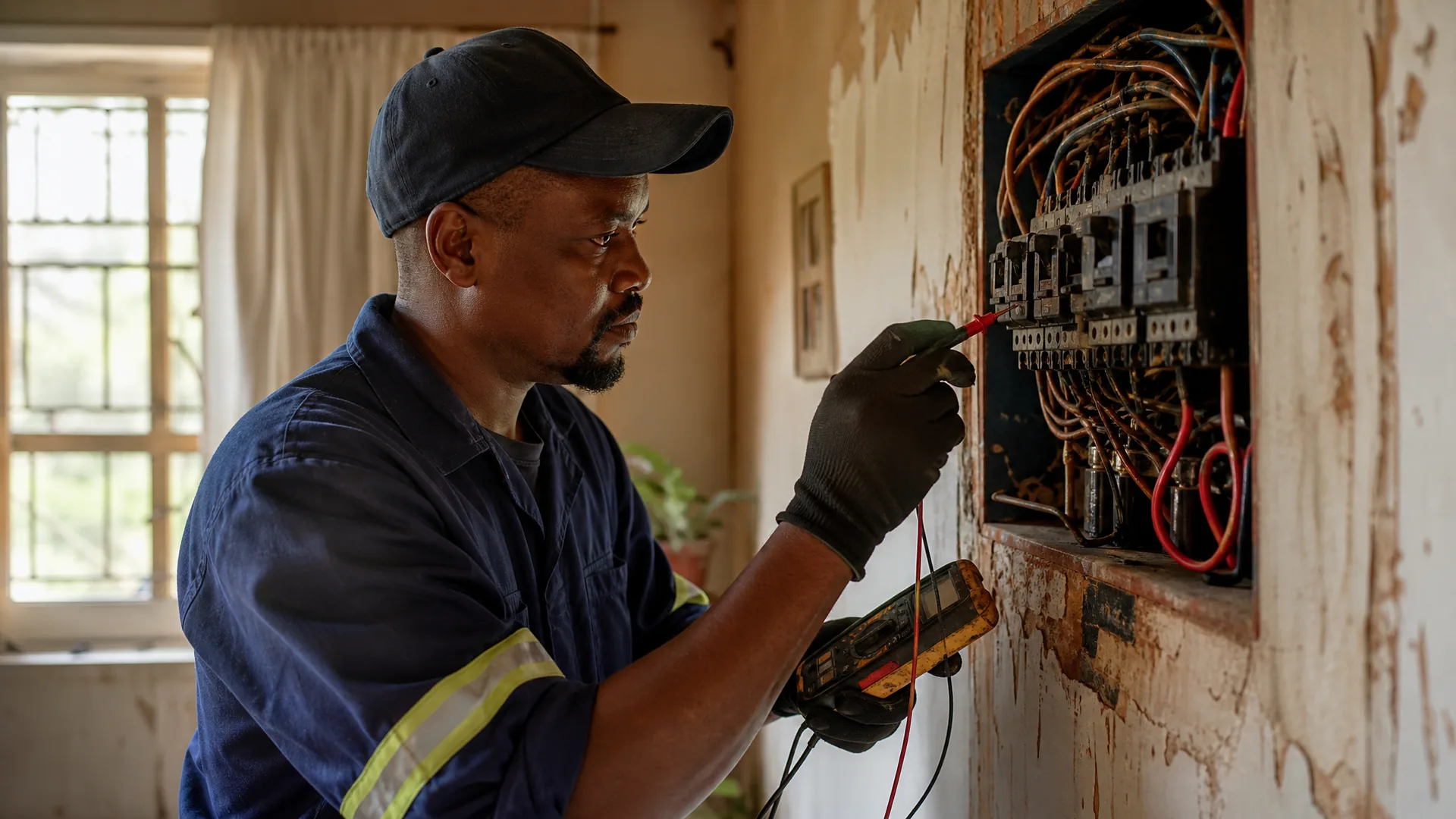
Once the visual check is complete, the electrician uses instruments to measure what can’t be seen. A multimeter confirms whether voltage and continuity are present at specific points. A loop impedance tester checks the earth fault loop path, confirming that a fault current would actually trip the protective device in time. An insulation resistance tester, commonly called a megger, applies a high DC voltage to the cable insulation to detect degradation. Insulation resistance testing is the most reliable way to confirm whether degraded cable insulation is causing intermittent faults, and it’s a step that gets skipped when homeowners attempt DIY diagnosis.
This phase maps directly to a formal residential electrical inspection, the same instruments, the same tests, applied to a specific fault rather than a whole installation.
Isolating the Fault to a Circuit or Device
With test results in hand, the electrician isolates the fault by systematically switching off circuits and retesting. This narrows the problem from the whole board down to a single circuit, then to a specific section or device on that circuit. Once isolated, the repair is targeted, no unnecessary work, no components replaced on spec.
Diagnostic Fees vs Free Assessment: What to Expect
Some electricians charge a call-out fee before they’ve looked at anything, or add a separate diagnostic charge on top of labour. This can make homeowners hesitant to call until a fault becomes serious. A free call-out model removes that barrier, you get a qualified electrician on-site to assess the fault without paying just for the visit. At Electricians Near Me, there is no call-out fee: the assessment is free, and you only pay for the work that needs doing. That makes it practical to get a professional opinion early, before a minor fault becomes a major one.
Finding Electrical Faults in Homes: When to Call an Electrician Immediately
Some faults can wait for a scheduled visit. These cannot:
- Burning smell from an outlet, switch, or distribution board, this indicates active heat damage and is a fire risk.
- Sparking or arcing at a plug point or switch, contact your electrician the same day.
- A circuit breaker that trips repeatedly and immediately on reset, something downstream is actively faulting.
- Flickering lights across multiple rooms simultaneously, this suggests a problem at the main supply or distribution board level, not a single circuit.
- Warm or hot switchgear, faceplates, or cable runs, heat in electrical infrastructure means resistance, and resistance means damage is already occurring.
South Africa’s wiring code, SANS 10142-1, requires that all electrical installations be tested and inspected before occupation and after any alteration, making professional fault diagnosis a legal compliance requirement, not just a practical one. If you’re experiencing any of the above, contact an emergency electrician near you rather than waiting for a standard appointment.
Attempting to investigate these faults yourself is dangerous. Beyond the immediate shock risk, disturbing a fault in progress can destroy evidence that helps an electrician diagnose it quickly.
Get Your Electrical Fault Diagnosed and Repaired, Free Call-Out
If you have a fault, tripping breakers, dead plug points, flickering lights, or anything else that doesn’t feel right, our qualified electricians will come to you, assess the problem, and give you a clear diagnosis at no call-out charge. All work is covered by a workmanship guarantee, and we’re available 24/7 for urgent electrical fault finding and repairs across South Africa. Book your free assessment now and get the fault found and fixed properly.

About author




Add comment